
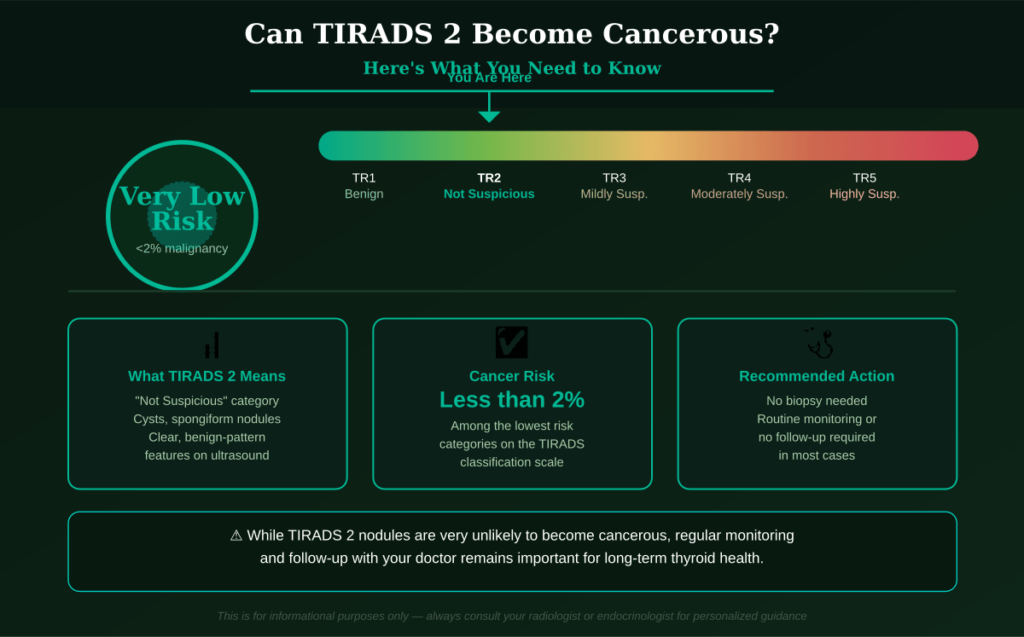
TIRADS, whose full meaning is Thyroid Imaging Reporting and Data System, is a rating system that typically classifies thyroid nodules based on their risk of malignancy.
The basis on which this categorization is done is achieved via features that the nodule displays when observed under ultrasound imaging.
The TIRADS system enables the standardization of the process and procedure that brings about the assessment and management of thyroid nodules.
Meanwhile, thyroid nodules are usually benign growths or lumps within the thyroid gland. Many of these nodules will not cause you any stress, but a few of them can become very problematic.
The nodules that are rated as TIRADS 2 (TR2) will often not cause any harm or pose any serious threat to your health. They are described as “not suspicious”.
However, in this article, you’ll learn whether there’s a risk of TIRADS 2 nodules later becoming cancerous, along with insights from related content.
Key Takeaway:
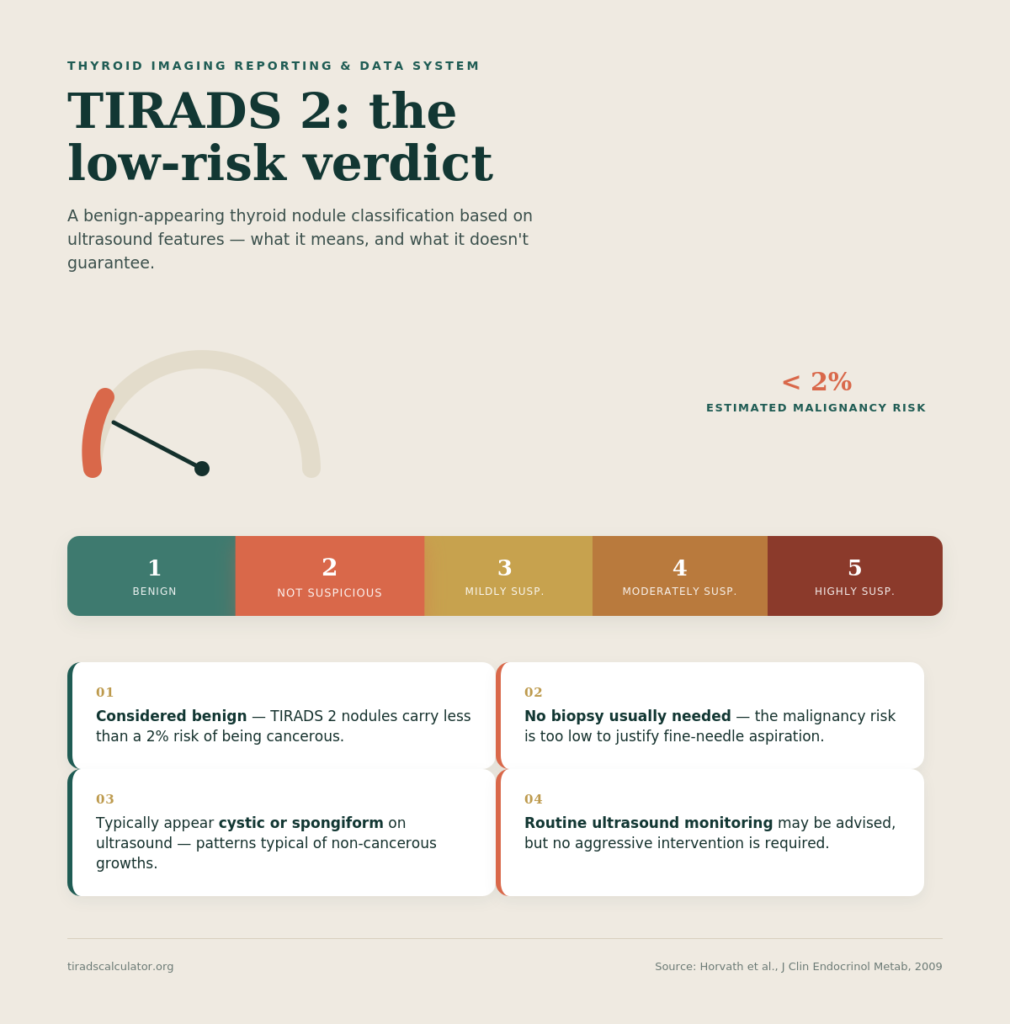
- TIRADS 2 nodules are considered benign, meaning they have a very low risk (less than 2%) of being cancerous.
- No biopsy is usually required for TIRADS 2 nodules due to their extremely low malignancy risk.
- These nodules often have simple cystic or spongiform appearance, which is typical of non-cancerous thyroid growths.
- Routine monitoring with ultrasound may be recommended, but no aggressive intervention is needed.
- Although rare, any sudden changes in size or characteristics should be evaluated by a healthcare provider.
Can TIRADS 2 Become Cancerous?
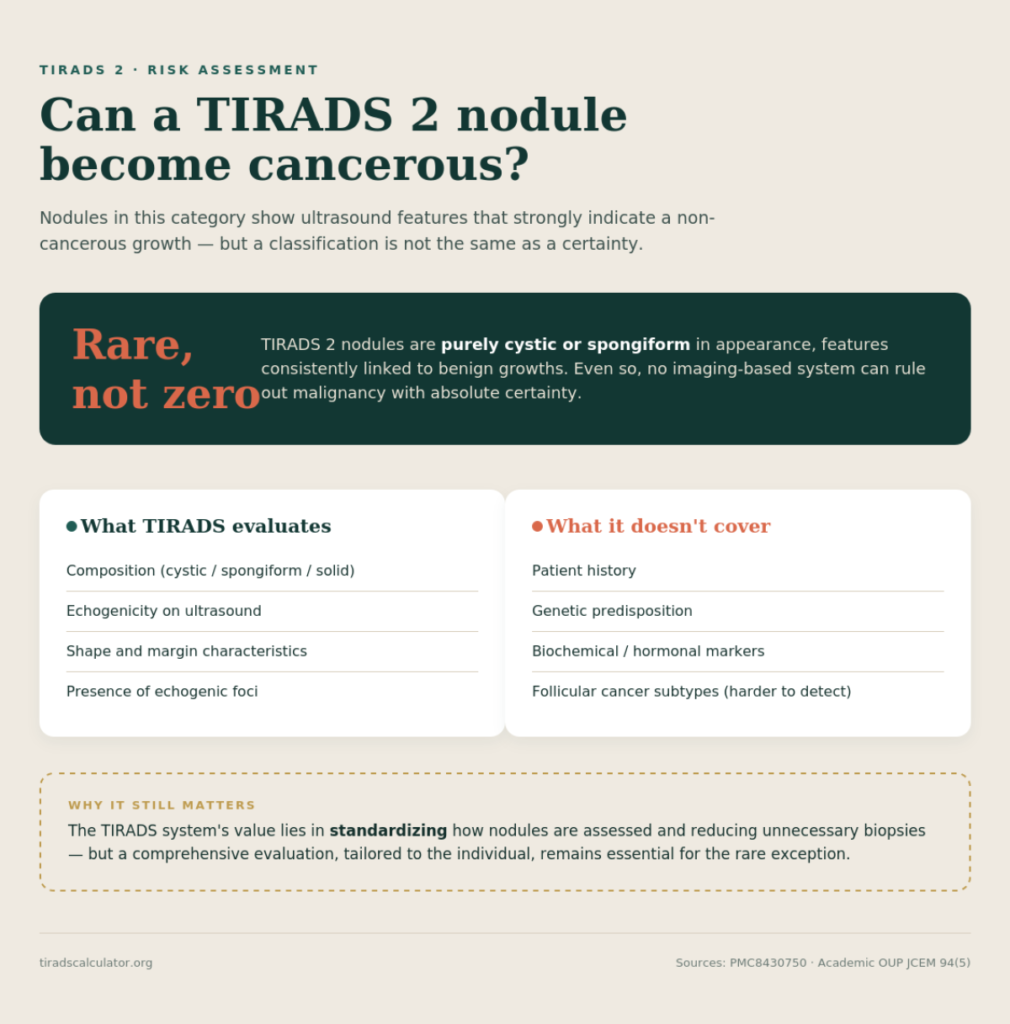
Nodules categorized under TIRADS 2 often come with a very low risk of becoming cancerous, and the features or characteristics that the nodules show by observing them using ultrasound imaging indicate non-cancerous growths.
For more information, check out here and here.
The low-risk affirmation of TIRADS 2 nodules basically indicates that it does not require any immediate follow-up or aggressive monitoring.
Even though these nodules are rated “not suspicious” and have a very low risk of becoming cancerous, you cannot completely rule out the possibility of becoming cancerous, even though such cases are very rare.
This is why the TIRADS rating system is a valuable tool with a major goal of ensuring that nodules are adequately distinguished according to their risk of malignancy, which is decided based on the ultrasound features they display.
For TIRADS 2 nodules, they usually display features like being purely cystic or spongiform. When this is adequately done, it’s easier to affirm that your thyroid nodule is benign and will not cause you any problems.
However, you must know with emphasis that the risk assessment service offered by the TIRADS rating system is based on imaging features, and it is not accountable for all other factors, including the patient history, genetic predisposition, or biochemical markers.
So, for things not to go wrong, a comprehensive evaluation is required, and an adequate management plan must be decided, specific to your thyroid condition.
For more information, check here and here.
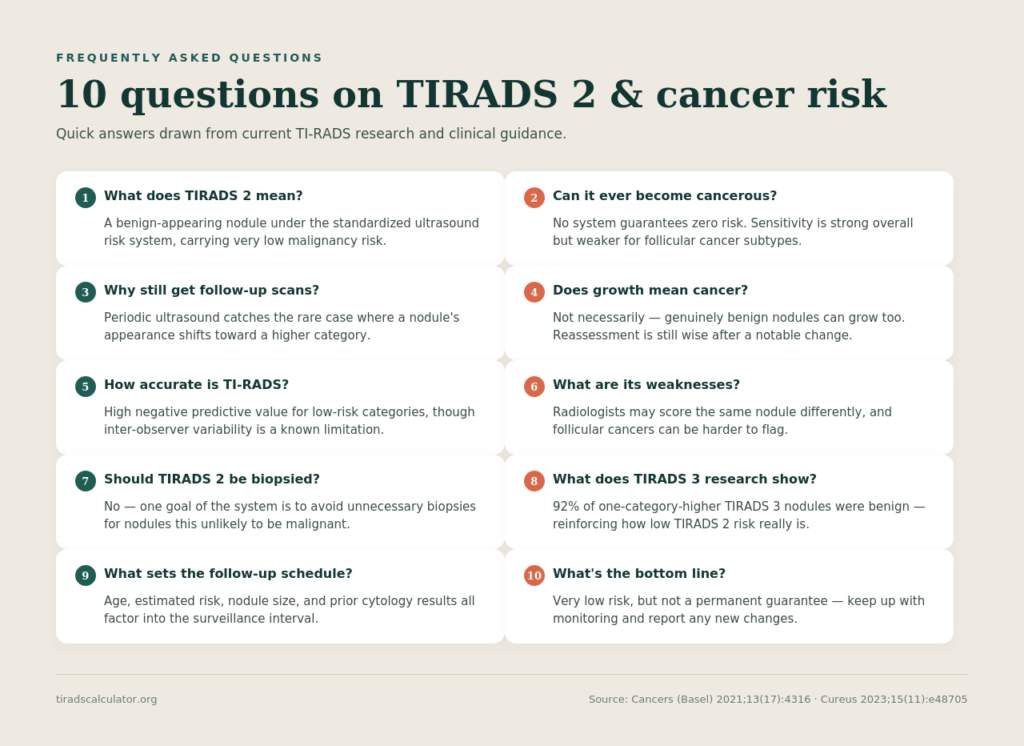
10 FAQs about whether TIRADS 2 thyroid nodules can become cancerous
What does a TIRADS 2 classification mean for a thyroid nodule?
TIRADS 2 represents a benign-appearing thyroid nodule under the TI-RADS classification system — a standardized ultrasound-based risk stratification tool. It carries a very low malignancy risk. The system was developed to help radiologists and clinicians communicate nodule risk consistently and guide decisions about whether a biopsy (fine-needle aspiration) is needed.
Can a TIRADS 2 nodule ever become cancerous?
While TIRADS 2 nodules are classified as benign, no classification system can guarantee zero cancer risk with absolute certainty. Research shows that TI-RADS systems carry high sensitivity and strong negative predictive values, but limitations remain — particularly in detecting follicular cancers and the follicular variant of papillary cancers, which can be harder to identify through ultrasound alone.
Why is regular follow-up still recommended even for TIRADS 2 nodules?
Current clinical guidelines recommend periodic ultrasound surveillance for benign thyroid nodules to detect any significant changes in size or appearance over time. Surveillance helps identify potential false-negative classifications — cases where a nodule initially appeared benign but later shows concerning features warranting re-evaluation toward TIRADS 3 or higher. Follow-up intervals depend on factors like age, sonographic risk estimate, nodule size, and prior cytology results.
Does nodule growth in a TIRADS 2 nodule mean it has become cancerous?
Not necessarily. While size increase has traditionally raised concerns about malignancy, recent evidence suggests that genuinely benign nodules can also grow over time. Growth alone is not a definitive indicator of cancer. However, any significant change in size or ultrasound appearance should prompt clinical reassessment and possible re-evaluation of the nodule’s risk category.
How accurate is the TI-RADS system in ruling out cancer in lower-risk nodules?
TI-RADS systems demonstrate satisfactory sensitivity and specificity for diagnosing malignancy, with high negative predictive values for lower-risk categories like TIRADS 2. However, studies note that no single system has shown a decisive diagnostic advantage over others, and inter-observer variability remains a known limitation across all TI-RADS systems.
What are the known weaknesses of TI-RADS that could affect TIRADS 2 reliability?
Two key weaknesses apply across all TI-RADS classification systems. First, there are remaining inter-observer discrepancies — different radiologists may score the same nodule differently. Second, the systems have insufficient sensitivity for detecting follicular thyroid cancers and the follicular variant of papillary cancers, which may not display classic high-risk ultrasound features and could theoretically be misclassified at a lower risk level.
Should a TIRADS 2 nodule automatically be biopsied to rule out cancer?
No. One of the primary goals of TI-RADS is to reduce the number of unnecessary fine-needle aspiration biopsies. TIRADS 2 nodules typically do not meet the size or feature thresholds that would trigger a biopsy recommendation. Performing biopsies on all low-risk nodules would result in a significant patient burden without meaningful clinical benefit, since the vast majority are benign.
What lessons can be drawn from TIRADS 3 research that apply to TIRADS 2?
A retrospective study at King Fahad Hospital found that 92% of TIRADS 3 nodules — one risk category above TIRADS 2 — were benign, with only 8% confirmed malignant. This reinforces that even intermediate-risk nodules are predominantly benign. For TIRADS 2, the benign proportion would be expected to be even higher. Importantly, the study concluded that TI-RADS alone should not drive clinical decisions; an integrated approach using multiple nodule features is essential.
What factors influence the follow-up schedule for a TIRADS 2 nodule?
Follow-up intervals for benign thyroid nodules are not one-size-fits-all. Guidelines factor in the patient’s age, the sonographically estimated malignancy risk, the nodule’s size, and whether prior cytology results are available. The risk spectrum spans from TIRADS 1 through TIRADS 4 and TIRADS 5, and management decisions scale accordingly. Researchers note there is still a need for further study to establish truly optimal surveillance protocols.
What is the overall clinical takeaway regarding TIRADS 2 and cancer risk?
TIRADS 2 nodules carry a very low risk of malignancy, and the TI-RADS classification system’s benefits — including standardized reporting, reduced unnecessary biopsies, and consistent risk communication — far outweigh its limitations. However, patients should not interpret a TIRADS 2 classification as a permanent guarantee of benignity. Ongoing ultrasound monitoring as directed by a physician remains important, and any new symptoms or nodule changes should be promptly discussed with a healthcare provider.
Conclusion
As you’ve seen from this article, you cannot entirely rule out the possibility of a TIRADS 2 nodule becoming cancerous, even though this occurrence is very rare. Adequate rating of your thyroid nodule must be done so as to help you receive the appropriate care based on the risk profile associated with your nodule.
Ordinarily, TIRADS 2 nodules will not require any aggressive follow-up, but it’s still advisable to manage your condition by periodically being involved in a follow-up with ultrasound to closely track any form of change in either the size or appearance of your nodule.
By doing this, any potential change will be tracked, detected on time, and effectively managed so that things do not go wrong.
Until there’s a significant change in the nature and characteristics of your nodule that indicates a dysfunction or malignancy, that’s when you will need regular biopsies or constant interventions.
Reference
- Eleonora Horvath, Sergio Majlis, Ricardo Rossi, Carmen Franco, Juan P. Niedmann, Alex Castro, Miguel Dominguez, An Ultrasonogram Reporting System for Thyroid Nodules Stratifying Cancer Risk for Clinical Management, The Journal of Clinical Endocrinology & Metabolism, Volume 94, Issue 5, 1 May 2009, Pages 1748–1751. Retrieved from here
- Russ G, Trimboli P, Buffet C. The New Era of TIRADSs to Stratify the Risk of Malignancy of Thyroid Nodules: Strengths, Weaknesses and Pitfalls. Cancers (Basel). 2021 Aug 26;13(17):4316. doi: 10.3390/cancers13174316. PMID: 34503125; PMCID: PMC8430750.
- AlSubaie R, Al Amer A, Al Najjar OA, Alali K, Al Makhaytah S, Al Amer M, AlAlwan QM, Almousa SS. Malignancy Rates in Thyroid Imaging Reporting and Data System Category 3 (TI-RADS 3) Thyroid Nodules: A Retrospective Study. Cureus. 2023 Nov 12;15(11):e48705. doi: 10.7759/cureus.48705. PMID: 38094553; PMCID: PMC10716603.